
Stockouts + overstocks despite planning effort
Planning inputs and signals are fragmented, so inventory buffers don’t reflect real uncertainty.
Planning inputs and signals are fragmented, so inventory buffers don’t reflect real uncertainty.

Teams discount to hit targets, but lack visibility into discount depth/frequency and margin impact by SKU.

Reports refresh late, and different teams calculate KPIs differently—leading to debate instead of action.

Store, marketplace, and D2C signals live in silos, making it hard to spot what’s driving growth.

Clean demand signals, forecast accuracy tracking, and service-level buffers tied to inventory levers.

Competitor indices, price ladders, discount leakage reporting, and rules for acquisition vs retention offers.

Sales vs target, stock cover, fill rate, late delivery exceptions—designed for daily intervention.

One semantic model, documented definitions, monitoring, and a weekly review cadence that drives usage.

Architecture + roadmap + MVP plan (what to build first, why, and how fast)

Curated models (product, inventory, orders, pricing/promo, store/region)

Role-based dashboards (Ops / Merch / Finance / Leadership)

Data quality + freshness monitoring and KPI governance approach
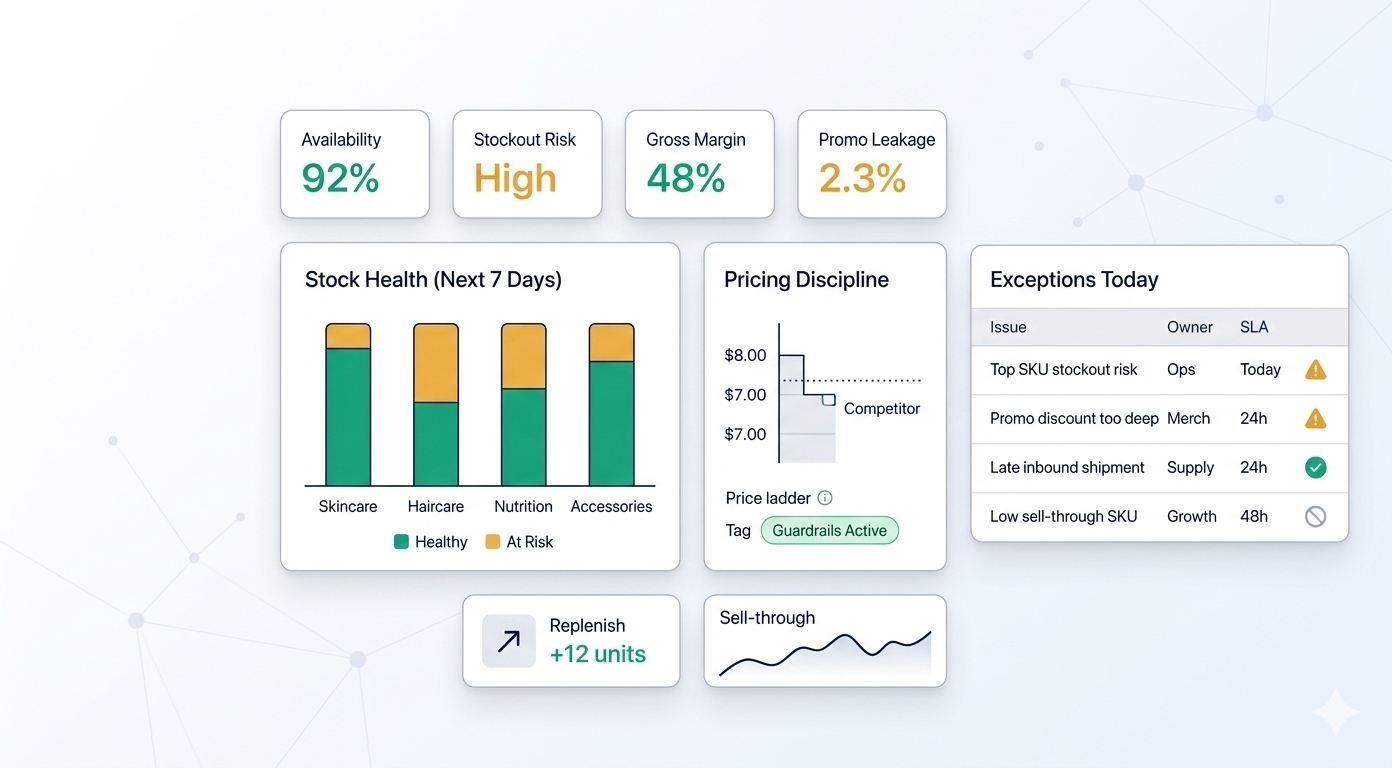
AI analyzes seasonality and demand signals to transform uncertainty into optimized inventory buffers—ensuring product availability while preventing overstock.
A system of dashboards and rules that shows discount depth/frequency, competitor indices, and margin impact by SKU and segment.
By implementing a governed semantic layer. This centralizes definitions and calculations into a “Single Source of Truth,” ensuring every department—from finance to sales—is looking at the same verified numbers.
Sales + inventory health + exception reporting (store/warehouse) with a KPI layer and a weekly operating cadence.
4–12 weeks depending on number of sources, refresh needs, and KPI alignment.