
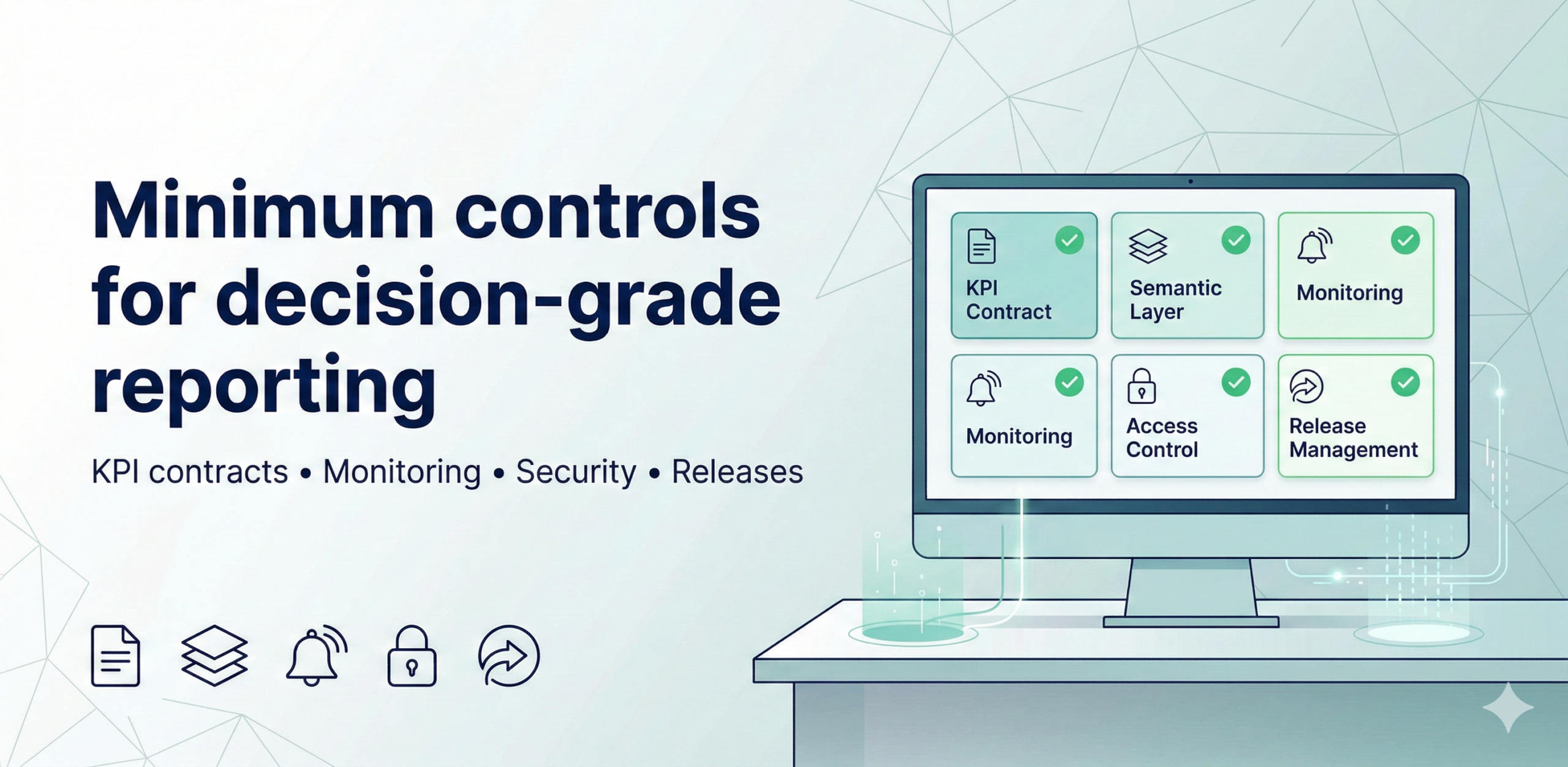
Decision-grade reporting requires five minimum controls: KPI contracts, a semantic layer, monitoring, security (RLS/access), and release/change management. Without these, KPI disputes and reporting incidents increase as the organization scales.
The minimum controls checklist (copy-paste)
These five controls are the non-negotiable foundation for any report that informs a business decision. They address the four most common failure modes: metric disagreement, silent data errors, unauthorised access, and regression after a code change. Implement them in order—each one builds on the last.
- KPI contracts (definition, grain, time, exclusions, owner) — A KPI contract is a written agreement—typically a short doc or a YAML file in version control—that specifies exactly how a metric is calculated. It records the business definition, the grain of the underlying data (e.g., one row per order line), the time-zone and attribution window, any explicit exclusions (e.g., internal test orders), and a named owner who signs off on changes. Without a contract, two analysts can produce different “revenue” figures from the same warehouse and both be correct by their own interpretation. The contract makes one interpretation official.
- Semantic layer (gold KPIs defined once, reused everywhere) — A semantic layer is a translation layer—implemented in a tool like dbt Metrics, Cube, or LookML—that encodes each gold KPI as a single, centrally maintained definition that every BI tool, notebook, and API query draws from. When the revenue formula changes, you update it in one place and every dashboard automatically reflects the new logic. Without a semantic layer, the same KPI gets re-implemented independently across dashboards, spreadsheets, and ad-hoc queries, diverging silently over time until stakeholders lose trust in the numbers.
- Monitoring (freshness, completeness, failures, anomalies) — Monitoring means automated checks running on every pipeline execution that verify four things: the data arrived on time (freshness), the expected volume of records was loaded (completeness), no pipeline steps threw errors (failures), and headline KPI values fall within statistically normal bounds (anomaly detection). Issues caught by monitoring are fixed before anyone opens a dashboard; issues missed by monitoring are discovered by an executive in a review meeting. The difference in business cost between those two outcomes is enormous.
- Security (RLS/roles, access reviews, auditability) — Row-Level Security (RLS) ensures that each user or role can only see the rows they are authorised to see—a regional manager sees their region’s data, not all regions. Role-based access controls determine which datasets and reports each team can reach. Access reviews (quarterly, at minimum) catch stale permissions from employees who changed roles or left the company. Auditability means every query and export is logged so you can answer “who saw this sensitive data and when?” All four are necessary to meet internal governance standards and most regulatory requirements.
- Release management (approvals, versioning, regression tests) — Release management treats changes to data models and reports the same way software engineering treats code deployments: no change goes to production without a peer review, a version tag, and a suite of regression tests confirming that existing gold KPI values have not shifted unexpectedly. This prevents the most common source of silent reporting breakage—a well-intentioned model change that alters a join, renames a field, or changes a filter and corrupts downstream metrics without triggering any alert.
MVP (4–6 weeks)
This six-week plan sequences the five controls in a logical build order, with each phase delivering a usable artefact. The goal at the end of week six is a fully governed, monitored, and access-controlled reporting layer that stakeholders can trust—built incrementally rather than as a big-bang project.
- Week 1: choose gold KPI set + contracts — Identify the 5–10 KPIs that appear in the most important leadership dashboards and generate the most cross-team disagreement. For each one, run a short workshop with the business owner to agree the definition, grain, time logic, and exclusions. Document the outcome in a KPI contract template and store it in version control. This week’s deliverable is a signed-off contract document—not code—but it is the foundation everything else is built on.
- Week 2–3: semantic layer + dimension standardization — Implement the agreed KPI contracts in your semantic layer tool (dbt Metrics, Cube, LookML, or equivalent). Standardise shared dimensions—date, geography, product hierarchy, customer segment—so every metric uses the same spine. Update existing dashboards to pull from the semantic layer rather than ad-hoc SQL. By the end of week three, your gold KPIs are defined in one place and any discrepancies between reports using the semantic layer are eliminated.
- Week 4: monitoring + integrity report — Deploy automated freshness, completeness, null-rate, and anomaly checks against the datasets that feed your gold KPIs. Route failures to the owning team via Slack or email. Build a one-page integrity dashboard showing SLA compliance and check pass-rates across all monitored assets. Establish a weekly 30-minute data quality review so the team has a regular ritual for triaging failures and tracking improvement over time.
- Week 5–6: release process + regression tests + rollout — Define and document the change management process: what counts as a breaking change, who must review it, what tests must pass before merge, and how rollbacks are handled. Write regression tests that assert the current values of your gold KPIs within acceptable tolerances and add them to the CI pipeline. Communicate the new process to the data team and roll it out as the mandatory path to production for all model and report changes going forward.
Control tests (must-have)
These five automated tests form the quality gate that every pipeline and model change must pass before reaching production. They can be implemented in dbt tests, Great Expectations, Soda, or plain SQL assertions. Running them on every deployment and scheduled execution ensures that failures are caught at the source—not in a leadership review.
- Duplicate key and join inflation tests — Asserts that primary and business keys (order_id, user_id, etc.) are unique within each table, and that join operations do not multiply rows unexpectedly. A single duplicated key in a fact table can inflate every downstream aggregate—revenue, order count, conversion rate—by an arbitrary multiplier with no obvious error message. These tests are the single highest-impact quality gate you can add to a data model.
- KPI regression tests for gold KPIs — Compares the current computed value of each gold KPI against a known-good baseline (e.g., last week’s certified output) and fails if the delta exceeds a defined tolerance (e.g., ±1%). This catches the most common cause of silent reporting breakage: a model or transformation change that inadvertently alters a calculation logic that other tests do not specifically check for.
- Freshness SLA checks — Queries the maximum load or event timestamp for each critical dataset and asserts it falls within the agreed SLA window. If the latest record is older than the threshold at the time the check runs, the test fails and an alert fires before any consumer queries the stale data. This is the fastest single test to implement and prevents the most common complaint: a dashboard showing yesterday’s numbers in today’s meeting.
- RLS leakage checks — Verifies that Row-Level Security rules are working as intended by querying the dataset as a restricted role and confirming that rows outside that role’s permitted scope are not returned. Leakage tests are critical when RLS is implemented at the BI layer rather than the warehouse layer, where a misconfigured filter or a report export can bypass the access control entirely and expose sensitive data to unauthorised users.
- Report refresh failure alerts + MTTR tracking — Monitors scheduled report and dashboard refreshes and fires an alert to the owning team whenever a refresh fails or exceeds its SLA. Mean Time to Recovery (MTTR) is tracked per asset so the team can identify which reports are chronically unreliable and prioritise remediation. Stakeholders who open a dashboard and see a stale “last updated” timestamp lose trust faster than almost any other data quality issue—this test ensures they are never the first to find out.